


-----------------------------------------
Payment and debt ratios[edit]
In most countries, a number of more or less standard measures of creditworthiness may be used. Common measures include payment to income (mortgage payments as a percentage of gross or net income); debt to income (all debt payments, including mortgage payments, as a percentage of income); and various net worth measures. In many countries, credit scores are used in lieu of or to supplement these measures. There will also be requirements for documentation of the creditworthiness, such as income tax returns, pay stubs, etc. the specifics will vary from location to location.
Some lenders may also require a potential borrower have one or more months of "reserve assets" available. In other words, the borrower may be required to show the availability of enough assets to pay for the housing costs (including mortgage, taxes, etc.) for a period of time in the event of the job loss or other loss of income.
Many countries have lower requirements for certain borrowers, or "no-doc" / "low-doc" lending standards that may be acceptable under certain circumstances.
Standard or conforming mortgages[edit]
Many countries have a notion of standard or conforming mortgages that define a perceived acceptable level of risk, which may be formal or informal, and may be reinforced by laws, government intervention, or market practice. For example, a standard mortgage may be considered to be one with no more than 70–80% LTV and no more than one-third of gross income going to mortgage debt.
A standard or conforming mortgage is a key concept as it often defines whether or not the mortgage can be easily sold or securitized, or, if non-standard, may affect the price at which it may be sold. In the United States, a conforming mortgage is one which meets the established rules and procedures of the two major government-sponsored entities in the housing finance market (including some legal requirements). In contrast, lenders who decide to make nonconforming loans are exercising a higher risk tolerance and do so knowing that they face more challenge in reselling the loan. Many countries have similar concepts or agencies that define what are "standard" mortgages. Regulated lenders (such as banks) may be subject to limits or higher risk weightings for non-standard mortgages. For example, banks and mortgage brokerages in Canada face restrictions on lending more than 80% of the property value; beyond this level, mortgage insurance is generally required.[6]
Foreign currency mortgage[edit]
In some countries with currencies that tend to depreciate, foreign currency mortgages are common, enabling lenders to lend in a stable foreign currency, whilst the borrower takes on the currency risk that the currency will depreciate and they will therefore need to convert higher amounts of the domestic currency to repay the loan.
Repaying the mortgage[edit]
In addition to the two standard means of setting the cost of a mortgage loan (fixed at a set interest rate for the term, or variable relative to market interest rates), there are variations in howthat cost is paid, and how the loan itself is repaid. Repayment depends on locality, tax laws and prevailing culture. There are also various mortgage repayment structures to suit different types of borrower.
Principal and interest[edit]
The most common way to repay a secured mortgage loan is to make regular payments toward the principal and interest over a set term.[citation needed] This is commonly referred to as (self) amortization in the U.S. and as a repayment mortgage in the UK. A mortgage is a form of annuity (from the perspective of the lender), and the calculation of the periodic payments is based on the time value of money formulas. Certain details may be specific to different locations: interest may be calculated on the basis of a 360-day year, for example; interest may be compounded daily, yearly, or semi-annually; prepayment penalties may apply; and other factors. There may be legal restrictions on certain matters, and consumer protection laws may specify or prohibit certain practices.
Depending on the size of the loan and the prevailing practice in the country the term may be short (10 years) or long (50 years plus). In the UK and U.S., 25 to 30 years is the usual maximum term (although shorter periods, such as 15-year mortgage loans, are common). Mortgage payments, which are typically made monthly, contain a repayment of the principal and an interest element. The amount going toward the principal in each payment varies throughout the term of the mortgage. In the early years the repayments are mostly interest. Towards the end of the mortgage, payments are mostly for principal. In this way the payment amount determined at outset is calculated to ensure the loan is repaid at a specified date in the future. This gives borrowers assurance that by maintaining repayment the loan will be cleared at a specified date, if the interest rate does not change. Some lenders and 3rd parties offer a bi-weekly mortgage payment program designed to accelerate the payoff of the loan.
An amortization schedule is typically worked out taking the principal left at the end of each month, multiplying by the monthly rate and then subtracting the monthly payment. This is typically generated by an amortization calculator using the following formula:
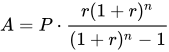
where:
- is the periodic amortization payment
- is the principal amount borrowed
- is the percentage rate per period divided by 100; for a monthly payment, take the Annual Percentage Rate (APR)/12/100
- is the number of payments; for monthly payments over 30 years, 12 months x 30 years = 360 payments.
 is the periodic amortization payment
 is the principal amount borrowed
 is the percentage rate per period divided by 100; for a monthly payment, take the
  is the number of payments; for monthly payments over 30 years, 12 months x 30 years = 360 payments.
Interest only[edit]
The main alternative to a principal and interest mortgage is an interest-only mortgage, where the principal is not repaid throughout the term. This type of mortgage is common in the UK, especially when associated with a regular investment plan. With this arrangement regular contributions are made to a separate investment plan designed to build up a lump sum to repay the mortgage at maturity. This type of arrangement is called an investment-backed mortgage or is often related to the type of plan used: endowment mortgage if an endowment policy is used, similarly a Personal Equity Plan (PEP) mortgage, Individual Savings Account (ISA) mortgage or pension mortgage. Historically, investment-backed mortgages offered various tax advantages over repayment mortgages, although this is no longer the case in the UK. Investment-backed mortgages are seen as higher risk as they are dependent on the investment making sufficient return to clear the debt.
Until recently[when?] it was not uncommon for interest only mortgages to be arranged without a repayment vehicle, with the borrower gambling that the property market will rise sufficiently for the loan to be repaid by trading down at retirement (or when rent on the property and inflation combine to surpass the interest rate)[citation needed].
Interest-only lifetime mortgage[edit]
Recent Financial Services Authority guidelines to UK lenders regarding interest-only mortgages has tightened the criteria on new lending on an interest-only basis. The problem for many people has been the fact that no repayment vehicle had been implemented, or the vehicle itself (e.g. endowment/ISA policy) performed poorly and therefore insufficient funds were available to repay balance at the end of the term.
source wiki
0 Response to "KRITIKAN PEDAS PD LARA ALANA AKN BUAT AWAL N SCHA MERAUNG?"
Post a Comment